
Zero Trust: What It Is and How to Implement It in Your Company

Updated: Jul 22
With the constant emergence of new digital vulnerabilities, it becomes essential to rethink security. The Zero Trust model stands out by requiring continuous verification, strengthening the protection of systems, resources, and people against cyber attacks. Learn more!

With the constant emergence of new vulnerabilities in digital environments, it becomes increasingly evident that resources, systems, and people themselves play a crucial role in security, either strengthening or weakening it.
For this reason, numerous security models have been and are constantly being created, and one of them argues that continuous verification is one of the most effective pillars for preventing cyber attacks.
In this context, the Zero Trust model stands out and is increasingly adopted as an effective strategy to block attacks and protect institutions against digital threats. Learn more!
What is Zero Trust?
Known by the motto “Never trust, always verify”, Zero Trust is a cybersecurity approach based on the principle that no user or device should be trusted by default — whether inside or outside the corporate network.
In other words, it is assumed that all connections, devices, and users, whether internal or external, are potentially insecure.
In this security model, constant verification and authentication are considered effective means of preventing cyber attacks. This approach helps to protect the organization against internal and external threats, significantly reducing the risk of security breaches.
Principles of Zero Trust
Zero Trust is an approach based on three principles:
Always verify: Authenticate and authorize based on all data, ensuring secure access.
Least privilege access: Limit user and system access to strictly necessary permissions.
Assume breach: Minimize impact, segment access, use end-to-end encryption, and analytics to detect threats and strengthen defense.
Technological Pillars of Zero Trust
This approach is based on the implementation of controls and technologies across seven technological pillars, which structure the security of the IT infrastructure. They are:
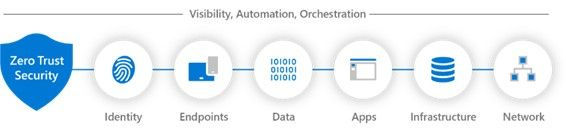
1. Identities
Verify all identities (users, services, devices) with strong authentication and least privilege access.
2. Devices (endpoints)
After authentication, data passes through various devices. This diversity increases the attack surface. Therefore, it is crucial to verify the integrity and compliance of devices before granting or maintaining access.
3. Data
Data must remain protected even outside the organization's systems. To achieve this, classify, label, and encrypt the data, applying access controls.
4. Applications
Manage and protect access to applications and APIs, ensuring that only verified users, devices, and identities can utilize them. Continuously monitor behavior to identify risks, misuse, and apply secure configurations that reduce vulnerabilities.
5. Infrastructure
Protect servers, VMs, containers, and microservices with secure configurations, access control, and threat detection.
6. Network
Segment the network, apply encryption, and monitor traffic to detect and prevent lateral movements and real-time attacks.
7. Visibility, automation, and orchestration
Integrate signals from all pillars to achieve a unified view. Use automation and orchestration to respond to threats more swiftly and make decisions based on reliable data. This pillar ensures real-time intelligence and automated response.
Based on the principle of Zero Trust — that no user or device should be trusted by default — ensuring security in companies has become a critical necessity. This is because a security breach can compromise not only sensitive data but also the reputation of the organization as a whole.
Zero Trust offers exactly this, through a modern approach that promotes a safer and more resilient environment by requiring continuous validation of identities, devices, and access. This model strengthens protection against internal and external threats, helping companies keep their digital assets secure.
Adopting Zero Trust is not a single product or solution, but a continuous security model that combines processes, people, and technology, being a strategic decision for the future of business security.
Talk to our experts, chart your security journey, and protect your business with Teltec Data!


